01
Robust
Intelligence should not be easily fooled by superficial changes, noise, or misleading information.
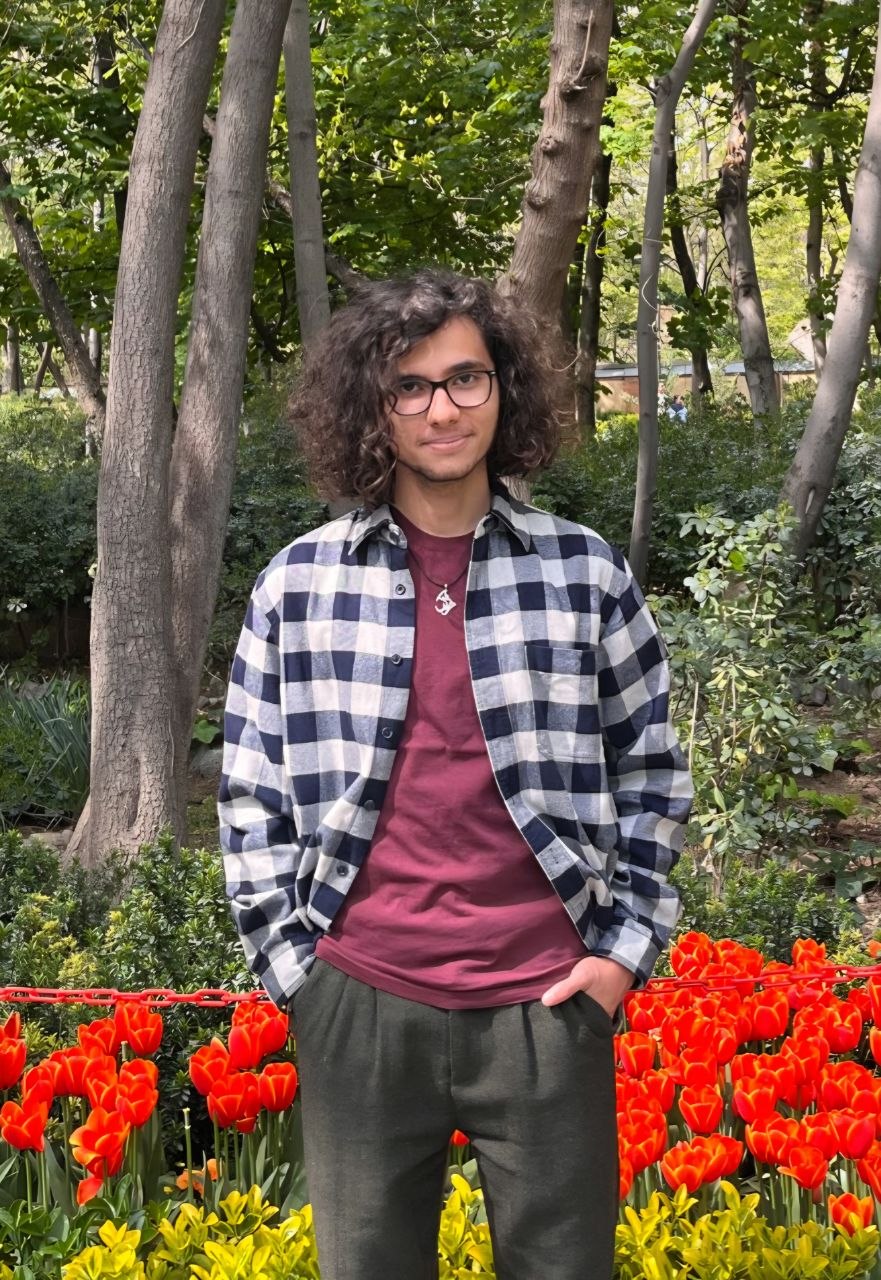
Hi! I'm Mazdak Teymourian, a recent graduate in Computer Engineering from Sharif University of Technology and a silver medalist in the National Physics Olympiad.
My background in physics has shaped how I approach research — I'm drawn to the mathematical and intuitive elegance underlying complex systems, and I try to carry that sensibility into my own work. In machine learning, this translates into a particular interest in intelligence that is robust, efficient, and interpretable. This interest led to work on fast adversarial training and catastrophic overfitting, accepted at ICML 2026, and on the decision-making mechanisms learned by neural combinatorial optimization solvers, a causal analysis currently under review at AAAI 2027. More recently, I've also been working on geometric approaches to understanding neural networks.
I'm also increasingly drawn to reinforcement learning and active inference, particularly the parallels between how these frameworks describe learning and decision-making and how the human brain appears to do the same.
Intelligence should not be easily fooled by superficial changes, noise, or misleading information.
Sophisticated behavior should not depend entirely on brute-force computation or scale.
Intelligence should be capable of discovering solutions and strategies that were not explicitly provided.
Complex capabilities can arise from relatively simple components through learning and interaction.
These questions have led me to explore how learning systems become robust, how sophisticated problem-solving behavior emerges, and how we can understand what a model has actually learned.
Decision-Making Mechanisms in Neural Routing Solvers
AAAI 2027 · Submitted
Neural solvers can discover effective strategies for difficult combinatorial problems. What heuristics and algorithmic structure have they actually learned?
Understanding Model Behavior Through Transformations and Neural Tangent Kernels
Ongoing research
Can the transformations a model is invariant to—or sensitive to—reveal the structure of what it has learned?
My research has moved from making learned systems more robust, to understanding how useful behavior emerges, and toward broader questions about how learning systems discover and represent structure.
Can intelligent systems remain reliable under perturbation and noise?
What mechanisms underlie the behavior learned by a neural network?
Can learning systems discover useful strategies that were never explicitly specified?
What deeper principles might connect learning, perception, action, and intelligence?
A few projects that show how I work beyond my main research: research implementation, literature synthesis, compiler construction, and computer architecture.
Reimplemented SORA and 14 named comparison methods in a unified PyTorch codebase, with visualization tools for comparing training and robustness behavior.
Surveyed research on non-stationary MDPs, dynamic regret, and adaptation methods, and synthesized the literature into a poster, presentation, video, and technical blog.
Implemented a compiler pipeline for C-Minus including lexical analysis, parsing, semantic analysis, and code generation.
Designed and implemented single-cycle, multi-cycle, and pipelined MIPS processor structures with registers, memories, ALU, and instruction support.
B.Sc. in Computer Engineering
Silver Medalist
Diploma in Mathematics and Sciences · National Organization for Development of Exceptional Talents (NODET)
TA across 10 courses spanning artificial intelligence, machine learning, deep learning, reinforcement learning, optimization, mathematics, game theory, computer simulation, and computer engineering.
Artificial Intelligence · Machine Learning · Deep Learning · Deep Reinforcement Learning · Convex Optimization · Linear Algebra · Probability & Statistics · Game Theory · Computer Simulation · Logical Circuit Design
Designed and graded Physics Olympiad problems in mechanics and electrostatics and conducted laboratory sessions covering physics experiments.
I am currently applying for Master's and PhD research positions in machine learning and related areas.